
The Vibe-Coder's Guide to Not Leaking API Keys
Vibe coding API keys leak when you paste them into the chat. 5 habits to keep secrets out of your agent — value-free minting, scoped keys, local.
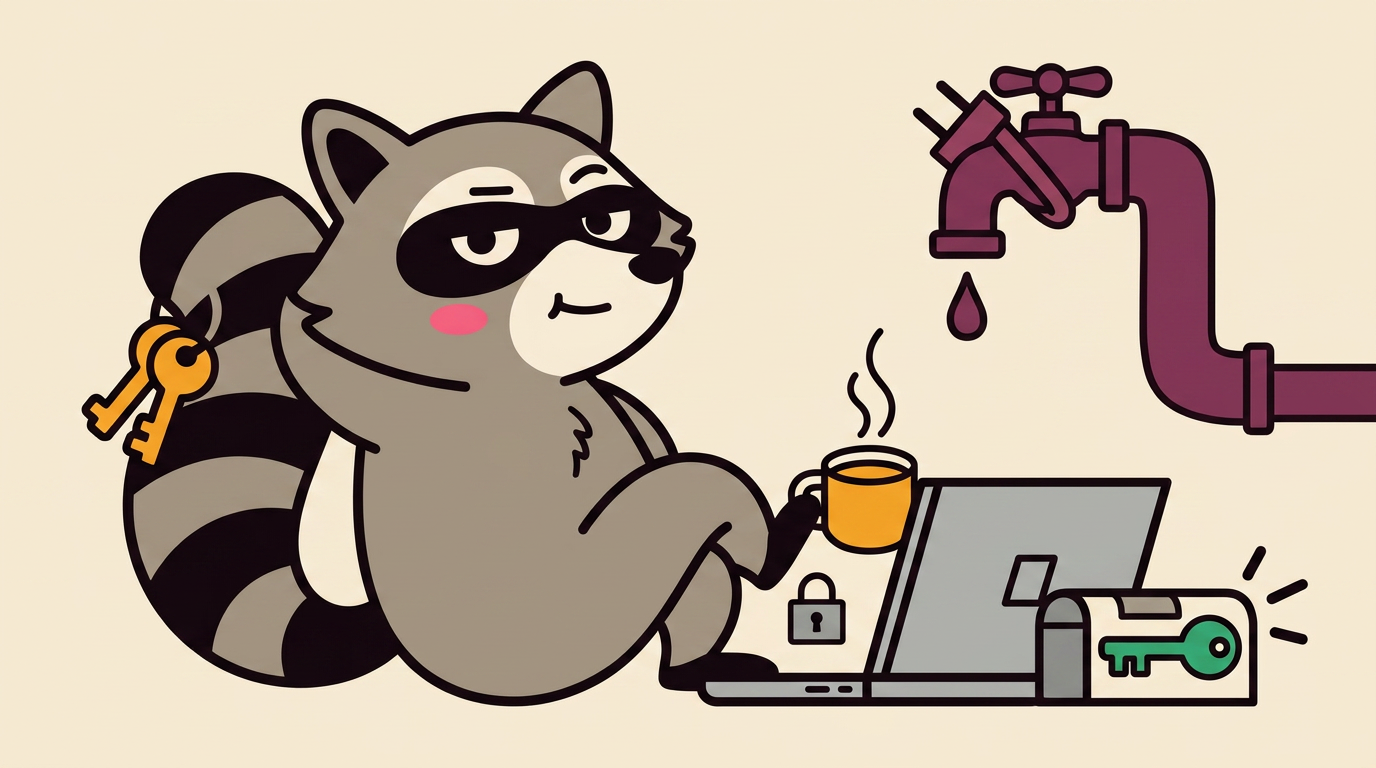
Rocco loves the vibe. He just won't let the keys ride shotgun in the chat window.

🦝 Rocco: ship fast. leak nothing. those aren't opposites.
Vibe coding fast doesn't mean leaking keys — the fix is to never paste a secret into your agent's chat and let a tool mint them value-free instead. Ringtail Keys is a local, open-source, agent-led tool that reads your .env.example and mints every scoped API key from the providers' official APIs, writing them to .env.local and Infisical — so the secret values never touch your coding agent or any model, no matter how fast you're moving.
How do vibe-coders leak API keys?
The leak almost always happens in the same spot: you're deep in flow with Claude Code or Cursor, something 401s, and you paste the live key into the chat so the agent can "help you debug." It works — and now your production secret is in the context window, the runtime logs, the inference provider's servers, and probably a screenshot in your Slack.
The other classic is committing an .env you meant to keep local, which is why GitHub's push protection for secrets exists at all. Vibe coding isn't uniquely careless — it's just fast, and speed multiplies the moments where a key ends up somewhere you didn't intend. The habits below remove those moments instead of asking you to be perfect at 2am.
🦝 Rocco: the leak isn't a hacker. it's you, pasting the key to fix a 401.
5 habits to keep API keys out of your agent
- Never paste a secret into the chat. If the agent needs to know a key exists, it needs the variable name, not the value. Full stop.
- Mint keys value-free. Let a tool provision keys so the values go straight to
.env.localand never enter the model's context in the first place. - Scope every key to one project. Least-privilege keys mean a leak is a small blast radius, not your whole account.
- Keep secrets out of git. An
.env.localin.gitignore, and let a tool manage the values — see stop committing secrets to git. - Use official APIs, not browser-bots. Don't run anything that types your password into a dashboard on your behalf; drive the providers' real APIs.
How does value-free minting fit a vibe-coding workflow?
It fits because it's less work, not more. Install the local daemon and point your agent at the repo:
curl -fsSL ringtail.sh | sh
ringtail up
ringtail up starts a local daemon with an MCP server. Your agent connects to it, reads the variable names in .env.example, and for each one asks Ringtail to mint a scoped key via that provider's official API. The provider returns the secret to the local daemon, which writes it to .env.local and syncs to Infisical. The agent hears "minted, validated" and keeps going. You never opened a token page, never pasted a key, never had a value to leak. One "allow" per provider the first time, then zero-touch.
For the guarantee behind this, see value-free credential provisioning, explained.
When should a vibe-coder reach for this — and when not?
Reach for it when:
- You spin up new projects constantly and don't want to re-extract the same keys by hand.
- You want your coding agent to wire up infra without you ever pasting a secret.
- You want least-privilege keys minted for you, scoped to each throwaway experiment.
Skip it when:
- You want a hosted vault to store keys you already have — that's storage, not acquisition.
- You need enterprise compliance governance — Ringtail is a local acquisition tool, not a governance suite.
- A provider has no key-minting API — Ringtail uses official APIs first and defers to a human login where none exists, never a bot with your credentials.
Doesn't going fast just mean accepting some risk?
That's the false trade the guide is built to kill. Speed and safety only conflict when the safe path is slower — and here it isn't. Pasting keys by hand is more steps than letting a tool mint them value-free; committing an .env and later scrubbing it from history is more work than never committing it. The secure habit is also the lazy one.
| Value-free (Ringtail) | Paste-and-pray vibe coding | |
|---|---|---|
| Keys in the chat | Never | Whenever you debug |
| Manual token-page raids | None | Every new project |
| Key scope | Least-privilege, per project | One over-scoped key everywhere |
| Where values live | Local .env.local + Infisical | Files + chat logs + screenshots |
| Speed | Faster — one command | Slower — manual + cleanup |
You don't slow down to be safe here; the safe version is the faster version. For giving an agent keys the right way, read how to give a coding agent API keys without leaking them.
What if I've already pasted a key into a chat?
Treat it as compromised and rotate it. Any key that's been in a context window should be considered leaked, because you can't audit everywhere that context traveled. Mint a fresh scoped key, swap it into .env.local and your sync, and let the old one die — how to rotate API keys without breaking production covers doing that cleanly. Then adopt the value-free habit so there's no next time. The point isn't guilt; it's that a scoped key is cheap to rotate and a leaked one is cheap to replace when the tool does the minting.
FAQ
How do vibe-coders avoid leaking API keys?
The main fix is to never paste a secret into your coding agent's chat and to mint keys value-free instead. With a tool like Ringtail Keys, your agent reads .env.example, mints each scoped key via the providers' official APIs, and the values land in .env.local and Infisical — never in the model's context. Combined with keeping .env.local out of git and scoping keys per project, that removes the moments where keys usually leak.
Why does pasting a key into Claude Code or Cursor leak it?
Because anything in the agent's context window can be logged by the runtime, sent to inference servers, and replayed in error reports and session transcripts — none of which you fully control. A live key pasted in to "help debug" is instantly copied into all of those. Value-free provisioning avoids this by making sure the agent never needs the value.
Is value-free provisioning slower than doing it by hand?
No — it's faster. Instead of visiting each provider's token page, guessing scopes, and pasting keys, you run one command and your agent mints every key from .env.example. Ringtail handles the minting, scoping, and syncing, so the secure path is also the path with fewer steps.
What should I do if I already pasted a key into a chat?
Rotate it. Assume any key that touched a context window is leaked, mint a fresh scoped replacement, swap it into .env.local and your sync, and retire the old one. Because Ringtail mints least-privilege keys and can rotate them without breaking prod, replacing a compromised key is quick.
How do I set up value-free minting?
Run curl -fsSL ringtail.sh | sh to install, then ringtail up to start the local daemon and MCP server. Point your coding agent at a repo with an .env.example, and it mints each scoped key value-free — values write to .env.local and Infisical while the agent only sees variable names. You approve one "allow" per provider the first time.